| Availability: | |
|---|---|
| Quantity: | |
TSE/TSH series
HS
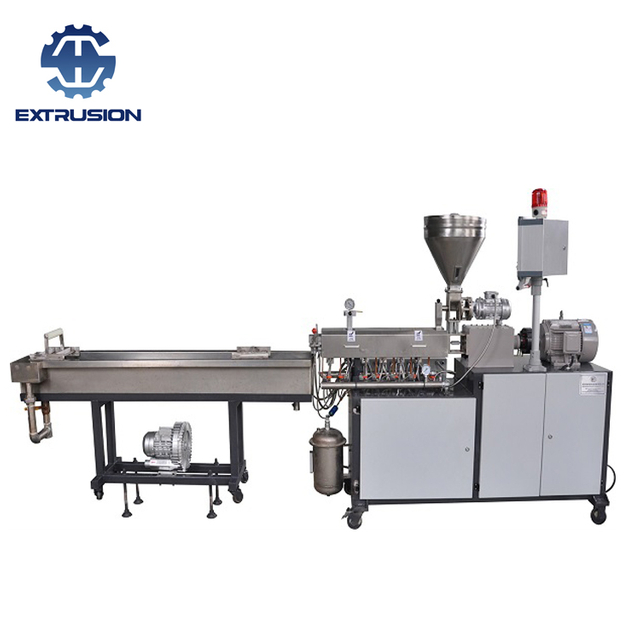
Laboratory grade extruder description:
The Lab Scale Extrusion Machine is a compact, high-performance system designed for small-scale extrusion experiments and material development. It allows researchers and manufacturers to test and optimize various polymer formulations, processing conditions, and product designs in a controlled environment. This machine is ideal for testing new materials, improving product quality, and scaling up production processes, offering flexibility and precision for laboratory-scale extrusion processes.
Parameter Table:
| Mode | Diameter(mm) | L/D | Speed (rpm) | Power (kw) | Capacity (kg/h) |
| TSE-40B | 41 | 32-52 | 600 | 45-55 | 100-160 |
| TSE-65B | 62.4 | 32-64 | 600 | 90 | 250-350 |
| TSE-75B | 71 | 32-64 | 600 | 132 | 350-550 |
| TSE-75D | 71 | 32-64 | 600-800 | 200-250 | 600-800 |
| TSE-95B | 93 | 32-64 | 600 | 315 | 800-1200 |

A twin screw lab extruder is a compact and versatile extrusion system designed for research, development, and small-scale production. It features co-rotating or counter-rotating twin screws, allowing precise control over material mixing, compounding, and reactive processing. Widely used in the plastics, pharmaceuticals, and food industries, this extruder enables efficient formulation testing, process optimization, and material innovation with minimal material waste.
Typical work:
Charateristics:
1.The gearbox
· New-style project of parallel three-axises driving makes the convey axis, convey chain, decelerate
and the torque assignment get together, which keep it compact, and the key bearings are imported.
· The select material of drive components is dainty, including super intension alloy cementiteing steel,
cementiting and quenching, gear grinding technics, strengthening of tooth face. So they can ensure high
torque, high precision and low noise.
· Soakage and coerce lubrication integrate smoothly. When the hydraulic circuit is over pressed, it alarms.
2.The feeding system
· Metering feeders are equipped with single screw, twin screw, hollow screw, forced-feeding, side feeding,
liquid-adding system,etc.
3.Screw
· The screw elements and then kneading blocks are designed accurately, by precise processed, agile
combination, with interchangeability, which can fulfill efficient self-cleaning, transmission, compounding,
pressure-forming.
· The screw material is made of high tool steel 38CrMoALA or W6Mo5Cr4V2 by special heat-treament.
4.The barrel
· Eurostyle rectangle barrel, reflux refrigeration is optimized and disposed, which makes temperature
difference in C areas smaller.
· According to the material and special techinics demands, the material of cylinder can use high quality
nitrided steel, corrosion proof or antifriction with corresponding process.
5.The heater
· Innovated design of heater tightened style insures high efficiency of heat transfer and high longervity
of heater.
6.Pelletizing
· Variou modes of pelletizing, such as water-cooling strand, air-cooling, water-ring, under water pelleting, etc.

Q&A: How to Choose the Right Laboratory Extruder for Pelletizing Applications
Q1: What is a Laboratory Extruder and What Is It Used For?
A laboratory extruder is a small-scale extrusion machine used for material research, formula development, and pilot production. It allows manufacturers to test plastic compounding and pelletizing processes before full-scale production.
Q2: What Is the Difference Between a Laboratory Extruder and an Industrial Extruder?
Laboratory extruders focus on flexibility, testing, and data collection with lower output capacity. Industrial extruders are designed for continuous large-scale production. Both use similar extrusion principles but serve different production stages.
Q3: What Materials Can Be Processed Using a Laboratory Extruder?
Laboratory extruders are mainly used for polymer compounding, biodegradable plastics, color masterbatch, filled compounds, and specialty plastic pellets. They are ideal for developing and testing new plastic formulations.
Q4: Why Is Pelletizing Important in Laboratory Extrusion?
Pelletizing converts processed plastic materials into uniform granules, which are easier to transport, store, and use in downstream manufacturing. It also ensures consistent material quality for testing and industrial production.
Q5: How Do You Choose the Right Laboratory Extruder?
Key factors include material type, required output capacity, process requirements (such as degassing or side feeding), and future scale-up needs. Selecting the right configuration ensures accurate testing and efficient transition to industrial pelletizing production.


The small-scale twin-screw extruder is designed for laboratory research and pilot production, providing precise control, excellent mixing, and stable performance for various polymer materials.NANJING HAISI is professional manufacturer of 20mm extruder, we supply Twin Screw Extruder, Single Screw Extruder, Plastic Recycling Extruder, Two Stage Extruder, Lab Scale Extruder, Mixing and Feeding Machine, Cooling and Pelletizing Machine, Crushing Machine and so on.
The Lab-Scale Twin Screw Extruder is designed for research and small-batch production, offering precise control and reliable performance for testing polymer formulations and compounding processes.
The Laboratory-Scale Extruder with Twin Screw is designed for research and small-scale production, providing precise control for material testing, formulation optimization, and polymer compounding experiments.
Laboratory grade extruder description:
The Lab Scale Extrusion Machine is a compact, high-performance system designed for small-scale extrusion experiments and material development. It allows researchers and manufacturers to test and optimize various polymer formulations, processing conditions, and product designs in a controlled environment. This machine is ideal for testing new materials, improving product quality, and scaling up production processes, offering flexibility and precision for laboratory-scale extrusion processes.
Parameter Table:
| Mode | Diameter(mm) | L/D | Speed (rpm) | Power (kw) | Capacity (kg/h) |
| TSE-40B | 41 | 32-52 | 600 | 45-55 | 100-160 |
| TSE-65B | 62.4 | 32-64 | 600 | 90 | 250-350 |
| TSE-75B | 71 | 32-64 | 600 | 132 | 350-550 |
| TSE-75D | 71 | 32-64 | 600-800 | 200-250 | 600-800 |
| TSE-95B | 93 | 32-64 | 600 | 315 | 800-1200 |

A twin screw lab extruder is a compact and versatile extrusion system designed for research, development, and small-scale production. It features co-rotating or counter-rotating twin screws, allowing precise control over material mixing, compounding, and reactive processing. Widely used in the plastics, pharmaceuticals, and food industries, this extruder enables efficient formulation testing, process optimization, and material innovation with minimal material waste.
Typical work:
Charateristics:
1.The gearbox
· New-style project of parallel three-axises driving makes the convey axis, convey chain, decelerate
and the torque assignment get together, which keep it compact, and the key bearings are imported.
· The select material of drive components is dainty, including super intension alloy cementiteing steel,
cementiting and quenching, gear grinding technics, strengthening of tooth face. So they can ensure high
torque, high precision and low noise.
· Soakage and coerce lubrication integrate smoothly. When the hydraulic circuit is over pressed, it alarms.
2.The feeding system
· Metering feeders are equipped with single screw, twin screw, hollow screw, forced-feeding, side feeding,
liquid-adding system,etc.
3.Screw
· The screw elements and then kneading blocks are designed accurately, by precise processed, agile
combination, with interchangeability, which can fulfill efficient self-cleaning, transmission, compounding,
pressure-forming.
· The screw material is made of high tool steel 38CrMoALA or W6Mo5Cr4V2 by special heat-treament.
4.The barrel
· Eurostyle rectangle barrel, reflux refrigeration is optimized and disposed, which makes temperature
difference in C areas smaller.
· According to the material and special techinics demands, the material of cylinder can use high quality
nitrided steel, corrosion proof or antifriction with corresponding process.
5.The heater
· Innovated design of heater tightened style insures high efficiency of heat transfer and high longervity
of heater.
6.Pelletizing
· Variou modes of pelletizing, such as water-cooling strand, air-cooling, water-ring, under water pelleting, etc.

Q&A: How to Choose the Right Laboratory Extruder for Pelletizing Applications
Q1: What is a Laboratory Extruder and What Is It Used For?
A laboratory extruder is a small-scale extrusion machine used for material research, formula development, and pilot production. It allows manufacturers to test plastic compounding and pelletizing processes before full-scale production.
Q2: What Is the Difference Between a Laboratory Extruder and an Industrial Extruder?
Laboratory extruders focus on flexibility, testing, and data collection with lower output capacity. Industrial extruders are designed for continuous large-scale production. Both use similar extrusion principles but serve different production stages.
Q3: What Materials Can Be Processed Using a Laboratory Extruder?
Laboratory extruders are mainly used for polymer compounding, biodegradable plastics, color masterbatch, filled compounds, and specialty plastic pellets. They are ideal for developing and testing new plastic formulations.
Q4: Why Is Pelletizing Important in Laboratory Extrusion?
Pelletizing converts processed plastic materials into uniform granules, which are easier to transport, store, and use in downstream manufacturing. It also ensures consistent material quality for testing and industrial production.
Q5: How Do You Choose the Right Laboratory Extruder?
Key factors include material type, required output capacity, process requirements (such as degassing or side feeding), and future scale-up needs. Selecting the right configuration ensures accurate testing and efficient transition to industrial pelletizing production.


The small-scale twin-screw extruder is designed for laboratory research and pilot production, providing precise control, excellent mixing, and stable performance for various polymer materials.NANJING HAISI is professional manufacturer of 20mm extruder, we supply Twin Screw Extruder, Single Screw Extruder, Plastic Recycling Extruder, Two Stage Extruder, Lab Scale Extruder, Mixing and Feeding Machine, Cooling and Pelletizing Machine, Crushing Machine and so on.
The Lab-Scale Twin Screw Extruder is designed for research and small-batch production, offering precise control and reliable performance for testing polymer formulations and compounding processes.
The Laboratory-Scale Extruder with Twin Screw is designed for research and small-scale production, providing precise control for material testing, formulation optimization, and polymer compounding experiments.
Email : info@hsextruder.com
Telephone: 86-25-52657506
Whatsapp: 86-18251820572
Address: 7 Zhongxing Road , Lishui Economic Development Zone, Nanjing, Jiangsu,China
Copyright © Nanjing Haisi Extrusion Equipment Co., Ltd.