Views: 2 Author: Site Editor Publish Time: 2026-08-06 Origin: Site
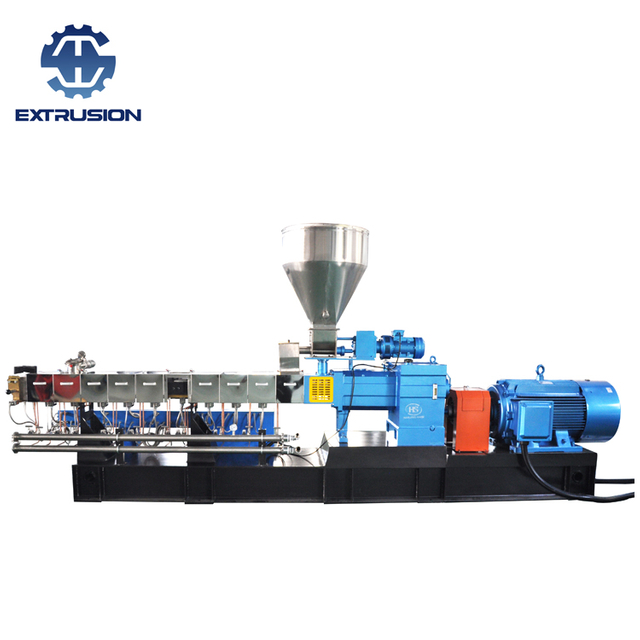
Plasticization refers to the process where plastic raw materials are uniformly melted and mixed under the combined action of heat and mechanical shear. This core task is entirely executed by the screw system of the primary extruder (main machine). Through an optimized screw profile, stable rotational speed, and precise temperature control, the primary extruder transforms raw materials into a homogeneous melt.
To judge whether the primary extruder’s plasticization is up to standard, check the following key indicators on the workshop floor:
Is the main motor current stable?
Is the vacuum vent port free from material surging (flooding) or "popping" (trapped gas escaping)?
Is the die head pressure stable without severe fluctuations?
Are the finished pellets completely free of micro-voids, unmelted gels, or particles?
If the primary extruder is not dialed in correctly, the plasticization will inevitably fail. The auxiliary machine (secondary extruder) is not designed to plasticize; therefore, it cannot "fix" or compensate for a poorly melted compound coming from the primary extruder.

Although the auxiliary machine does not actively participate in the melting process, its operating conditions heavily dictate the visual appearance and structural integrity of the extruded pellets. This impact is primarily seen in three areas:
The RPM of the auxiliary machine must be perfectly synchronized with the output volume of the primary extruder.
If the auxiliary speed is too low: The polymer melt will stagnate and accumulate before the die head. This excessive residence time often leads to thermal degradation, yellowing, or carbonization of the pellets.
If the auxiliary speed is too high: The melt is pushed forward too aggressively and is not adequately compacted. This lack of pressure can cause internal micro-voids inside the pellets.
The heating zones on the auxiliary machine function primarily as thermal insulation—they maintain the melt at the optimal flow viscosity before it enters the die plate. If the auxiliary temperature is set too low, the surface of the extruded strands will become rough, and the final pellets will lose their surface gloss. Operators often mistake this dull appearance for "poor plasticization," when it is actually a temperature transition issue.
If the screen changer or breaker plate on the auxiliary machine becomes heavily clogged, the resistance against the melt flow spikes. This severely disrupts the extrusion speed, leading to inconsistent strand diameters, frequent strand breakages, and ultimately, deformed and asymmetrical pellets that ruin the product's premium appearance.
In summary, the primary extruder is the absolute deciding factor for plasticization quality; the auxiliary machine cannot replace it. However, the auxiliary machine's RPM, temperature settings, and filtration condition directly dictate the final pellet's appearance, density, and gloss.
The correct workshop strategy: Dial in and stabilize the primary extruder first to lay the foundation. Then, fine-tune the auxiliary machine to ensure the perfectly plasticized melt is smoothly transferred, filtered, and extruded. Only when both machines perform their specific roles in perfect harmony can you guarantee stable production and premium pellet quality.

NANJING HAISI is professional manufacturer of Plastic Extruder Machine, we supply Twin Screw Extruder, Single Screw Extruder, Plastic Recycling Extruder, Two Stage Extruder, Lab Scale Extruder, Mixing and Feeding Machine, Cooling and Pelletizing Machine, Crushing Machine and so on.