Views: 17 Author: Site Editor Publish Time: 2026-04-16 Origin: Site
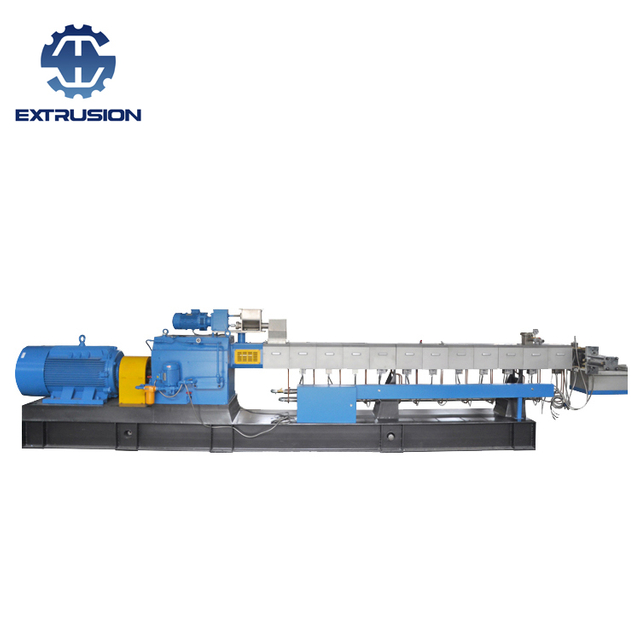
In the world of modified plastics and recycling, the extruder is more than just a machine—it is the "heart" of the entire pelletizing line. While single-screw extruders were once the industry standard, Twin-Screw Extruders (TSE) have become the dominant force in high-performance granulation due to their superior mixing capabilities and process flexibility.
At Nanjing Haisi Extrusion, we specialize in advanced twin-screw technology. Understanding the fundamental differences between these systems is crucial for producing high-consistency pellets.

1. Co-Rotating Twin-Screw vs. Single-Screw: The Principles of Pelletizing
While a single-screw extruder relies on friction to move material (known as drag flow), the co-rotating twin-screw extruder operates on entirely different mechanical principles:
• Forced Conveying: In a co-rotating system, the screws intermesh. Material is pulled into the gap of one screw and pushed out by the other, moving in a forced "∞" (figure-eight) pattern. This ensures the material moves forward predictably, regardless of the polymer's friction coefficients.
• Superior Homogenization: The intermeshing zone creates high shear rates and turbulent flow. This results in mixing quality that far surpasses single-screw extruders, making it ideal for compounding and masterbatch pelletizing.
• Self-Cleaning Mastery: Because the screws wipe each other as they rotate, they continuously scrape off any stagnant material. This prevents local thermal degradation and ensures that the material's residence time is short and uniform—vital for producing high-purity pellets.
• Starve Feeding: Unlike single-screw machines that usually run "flood-fed" (hopper completely full), co-rotating TSEs use metered starvation feeding. This allows the screw speed to act as an independent variable, giving operators precise control over shear intensity and melt temperature.
2. Applications: Where Co-Rotating TSE Excels
For most modern compounding and pelletizing needs, co-rotating twin-screw extruders are the industry's gold standard. They are the preferred choice for:
• Glass Fiber Reinforcement: Granulating engineering plastics like PA6, PA66, PET, PBT, PP, and PC.
• High-Fill Masterbatches: Pelletizing PE or PP filled with up to 80% Calcium Carbonate ($CaCO_3$) or talc.
• Functional Masterbatches: Producing antistatic, flame retardant, and high-concentration color pigments.
• Reactive Extrusion: Such as TPU, EVA, or hot-melt adhesive granulation.
3. Counter-Rotating Twin-Screw: The Specialist for PVC Granulation
While co-rotating screws are the kings of mixing, they generate significant shear heat. For thermal-sensitive materials like PVC, this excessive heat can lead to rapid material degradation. This is where Counter-Rotating Twin-Screw Extruders step in.
Why use Counter-Rotating technology for PVC Pellets?
1. Low-Shear, Low-Heat Processing: The material is moved via "positive displacement" (similar to how a gear pump works). Because the screws rotate in opposite directions, they convey the material at lower speeds with minimal shear heat, preventing the PVC from decomposing or burning during the pelletizing process.
2. High Pressure Stability: Counter-rotating screws are exceptionally good at building stable pressure at the die head, which is essential for consistent strand extrusion or die-face cutting.
3. Cost-Efficiency: Using a counter-rotating twin-screw extruder for PVC powder granulation allows manufacturers to skip the pre-plasticization step that single-screw machines often require, significantly lowering overall production costs.
4. Head-to-Head Technical Comparison
To make the right choice for your granulation line, here is how the three main extrusion technologies stack up against each other:
• Single-Screw Extruders: These rely on friction (drag flow) to convey material and are typically flood-fed. While they are cost-effective for simple polymers and stable profile extrusion, they offer only basic distributive mixing, moderate shear, and poor self-cleaning capabilities, making them less ideal for complex compounding tasks.
• Co-Rotating Twin-Screw Extruders: Utilizing a forced figure-eight flow mechanism, these machines are fed via precision starvation feeding. They deliver excellent dispersive mixing, high and adjustable shear intensity, and outstanding self-cleaning properties. This makes them the ultimate choice for compounding, functional masterbatches, and high-fill granulation.
• Counter-Rotating Twin-Screw Extruders: Operating on a positive displacement principle with starvation feeding, these extruders provide moderate mixing and good self-cleaning. Their standout feature is the strictly controlled, low-shear environment they create, which is absolutely essential for the safe, stable granulation of heat-sensitive formulations like PVC and XLPE cable materials.
5. Why Modern Pelletizing Demands Flexibility
The greatest advantage of the twin-screw system (especially the co-rotating type) is its modular design. At Nanjing Haisi, our screw elements and barrels function like precision "building blocks." We can arrange different kneading, mixing, and conveying elements to perfectly match your specific formulation—be it high-fill, flame retardant, or recycled cable material.
While a twin-screw machine might seem more complex initially, its ability to handle high-output granulation with lower energy consumption per kilogram of pellets makes it the most economical choice for long-term industrial production.
Conclusion
Whether you are producing high-end engineering plastic pellets or recycling heat-sensitive PVC, the choice between co-rotating, counter-rotating, or single-screw technology will directly dictate your product quality and profit margins.
As a dedicated manufacturer of plastic pelletizing machines, Nanjing Haisi Extrusion Equipment Co., Ltd. offers tailor-made extrusion solutions to ensure your granules are consistent, high-density, and market-ready.

NANJING HAISI is professional manufacturer of Plastic Extruder Machine, we supply Twin Screw Extruder, Single Screw Extruder, Plastic Recycling Extruder, Two Stage Extruder, Lab Scale Extruder, Mixing and Feeding Machine, Cooling and Pelletizing Machine, Crushing Machine and so on.