Views: 0 Author: Site Editor Publish Time: 2026-10-12 Origin: Site
Simply defined, the Length-to-Diameter (L/D) ratio is the proportion of the screw's effective working length to its outer diameter. Many plant engineers instinctively believe that a longer screw forces the polymer to linger longer, guaranteeing superior plasticization and blending. While moving from short configurations to longer barrels was indeed driven by the need for higher throughput and complex blending, blind maximization introduces severe engineering risks.

The push toward higher L/D ratios—ranging from 36 to 48 and beyond—stems from three primary operational advantages:
Ample Homogenization Time: Solid polymer pellets require adequate time to absorb thermal conduction and frictional shear heat. A larger L/D ratio ensures the melt experiences a stable, gradual transition across functional zones.
Higher Production Capacity: With a longer barrel, operators can push screw RPM higher. Even though material moves faster through the machine, the extended length guarantees complete melting before discharge, elevating overall output.
Complex Additive Integration: Modern masterbatch and modification recipes often require multiple side-feeders for glass fibers and mineral fillers, alongside multiple vacuum venting ports. A longer barrel provides the physical real estate necessary to stage these complex processing steps.
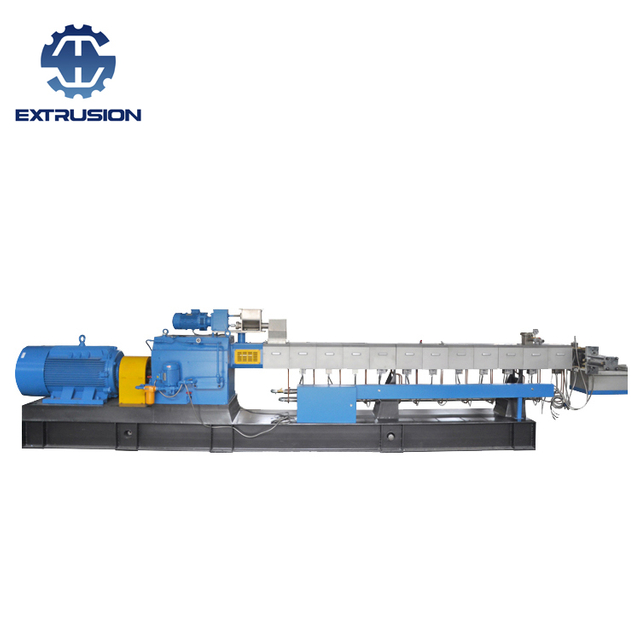
When operating a high-torque twin screw compounding extruder, these expanded capabilities allow plants to handle demanding formulations that shorter legacy machines cannot process.
While longer screws offer incredible versatility, pushing L/D to extremes without a clear processing objective invites major equipment failures:
Thermal Degradation and Discoloration: Exposing polymer melts to high shear and elevated temperatures for extended durations dramatically increases the risk of molecular chain scission. For heat-sensitive or recycled materials, excessive residence time causes yellowing, polymer breakdown, and catastrophic losses in mechanical strength.
Shear Heat Runaway: As the screw length increases, frictional shear heat accumulates aggressively. If the barrel cooling system cannot extract this thermal energy quickly enough, localized overheating occurs, leading to polymer scorching and dead-zone sticking.
Mechanical Stress and Deflection: A long, slender screw acts mechanically like a long rod under intense axial compression. Extreme L/D ratios increase shaft deflection, vibration, and component wear, raising the risk of metal-to-metal barrel scoring.
To prevent these issues on a co-rotating twin screw extruder, engineers must balance formulation dwell requirements against the physical limits of the barrel length.
There is no universal L/D ratio that fits every polymer system. Industry experience points to distinct "golden intervals" based on specific processing goals:
L/D = 28 to 32 (Standard Single-Screw / Basic Reclaim): Ideal for standard extrusion or basic pellet recycling where stable conveying and simple temperature control take priority over intensive distributive mixing.
L/D = 36 to 40 (The Compounding Workhorse): The industry standard for general co-rotating compounding and masterbatch production, providing balanced dispersion while keeping residence times safe.
L/D = 44 to 48 (High-Difficulty / Multi-Component): Tailored for heavily filled formulations (e.g., 70%+ mineral-loaded masterbatches), high-percentage glass fiber reinforcement, or deep devolatilization processes requiring extensive vacuum venting.
L/D≥ 52 (Specialized Reactive Extrusion): Reserved for niche chemical reactions, such as macromolecular grafting. These systems present severe thermal control challenges and are rarely required for standard compounding.
If your existing line features a fixed L/D ratio that causes thermal degradation or poor mixing, experienced engineers rely on several targeted adjustments:
Dynamic Residence Time Control: If the screw is too long and material is scorching, increase screw RPM or feed rates (shifting from a starved feed toward a fuller feed) to accelerate throughput and shorten average dwell time. Conversely, if the screw is too short and plasticization is incomplete, lower the RPM slightly or adjust barrel temperature profiles to compensate for length with thermal energy.
Reconfiguring Screw Elements: On modular systems, you can reduce excessive shear by swapping high-shear 90-degree kneading blocks for forward-conveying elements or wider-angle blocks (such as 45 degrees). This weakens the shear profile while accelerating material flow, achieving gentle dispersion without degradation.
Strict Melt Temperature Monitoring: Never rely solely on barrel heater display panels. Monitor actual melt temperatures at the vacuum vent and die head exit. If melt temperatures exceed safety thresholds, immediately adjust screw speed and upstream thermal zones.
When specifying a plastic pelletizing machine, the correct L/D ratio is a matter of metallurgical and thermal engineering precision. Selecting the optimal length ensures flawless homogenization, efficient devolatilization, and minimal thermal history.

If you are evaluating custom screw profiles or selecting machinery for challenging formulations, the technical team at Nanjing Haisi Extrusion is ready to engineer a tailored solution for your plant.