Views: 0 Author: Site Editor Publish Time: 2026-11-26 Origin: Site
Anyone working in polymer compounding, modification, or downstream molding immediately notices a sharp visual contrast between virgin resins and low-grade regrind. Virgin PLA, PBAT, PP, and PE granules supplied by major petrochemical producers exhibit remarkably consistent particle sizes and smooth geometries—either spherical beads or uniform cylinders. In contrast, basic recycled plastics often contain irregular flakes, jagged fragments, and high dust loads.
Industrial manufacturing does not prioritize spherical geometry purely for aesthetics. Rather, downstream extrusion, injection molding, blown film, and fiber-spinning lines require standardized, predictable feedstock. Uniform pellet morphology directly governs feeding consistency, conveying efficiency, and melt stability.

Before entering an extruder throat, raw resins travel from bulk bags or silos through hoppers and feeding chutes. Irregular flakes, long tails, and mixed fines interlock mechanically, causing bridging and rat-holing inside hoppers. Uniform pellets roll freely past one another, ensuring steady mass flow and minimizing operator intervention on automated lines.
Modern compounding plants transfer resins across long distances using closed-loop pneumatic conveying lines. During high-velocity transport, pellets collide repeatedly with pipe walls and each other. Sharp corners and brittle fragments shear off easily, generating fines that clog dust collectors and create housekeeping hazards. Smooth, uniform pellets resist mechanical attrition, lowering material loss over extended conveying runs.
Consistent processing relies on precise mass delivery. When pellet sizes vary widely, bulk density fluctuates inside volumetric dosing screws, leading to formulation drift and uneven additive ratios. Uniform pellet dimensions maintain a predictable bulk density, allowing feeders to meter exact weights continuously.
Inside an extruder barrel or injection molding cylinder, pellets must absorb conductive and shear heat at a predictable rate. If a batch contains both fine dust and oversized chunks, the fines melt prematurely and risk thermal degradation while oversized pieces remain unmelted, creating gels or surface defects. Consistent pellet size ensures uniform thermal transfer and homogeneous plasticization.
Uniform granules flow predictably through high-speed bagging machines and automated bulk-loading spouts. While spherical geometry does not always yield the absolute highest theoretical packing density, its predictable flow behavior prevents segregation and simplifies automated inventory handling.
While several methods produce uniform granules, an underwater pelletizing system is the primary continuous technology used to manufacture spherical polymer beads at industrial scale.
Melt Plasticization and Filtration: Polymer melt exits the extruder, passes through a screen changer to remove impurities, and enters a heated die plate containing precision-drilled micro-orifices.
Die-Face Cutting in Process Water: The die face is submerged inside a closed water chamber. High-speed rotating knives sweep directly across the die plate, shearing the emerging molten polymer strands instantaneously.
Surface Tension Rounding: Because the polymer is cut while still molten, surface tension pulls the freshly severed droplets into spherical or ellipsoidal shapes as they enter the circulating tempered water stream.
Cooling, Dewatering, and Screening: The tempered water solidifies the pellets and transports them to a centrifugal dryer, where moisture is stripped away before a vibratory screener removes any agglomerates or fines.
By adjusting die hole diameters, cutter RPM, melt temperature, and process water temperature, operators control final bead diameter and roundness across a wide range of polyolefins, elastomers, and biodegradable polymers.
Not all spherical resins are formed via melt extrusion. Certain polymers—such as expandable polystyrene (EPS) or specific PVC grades—form beads directly during suspension polymerization. Liquid monomer droplets are dispersed in water using chemical stabilizers and controlled agitation; as the chemical reaction progresses, the droplets solidify directly into spherical polymer beads without requiring a secondary melt-pelletizing step.
Post-consumer recycled resins frequently appear as irregular flakes or cylindrical pellets due to how they are processed:
Washed Regrind Flakes: Rigid plastics (like HDPE bottles or PP crates) are often shredded, washed, and dried for direct reuse without re-melting, resulting in jagged flakes.
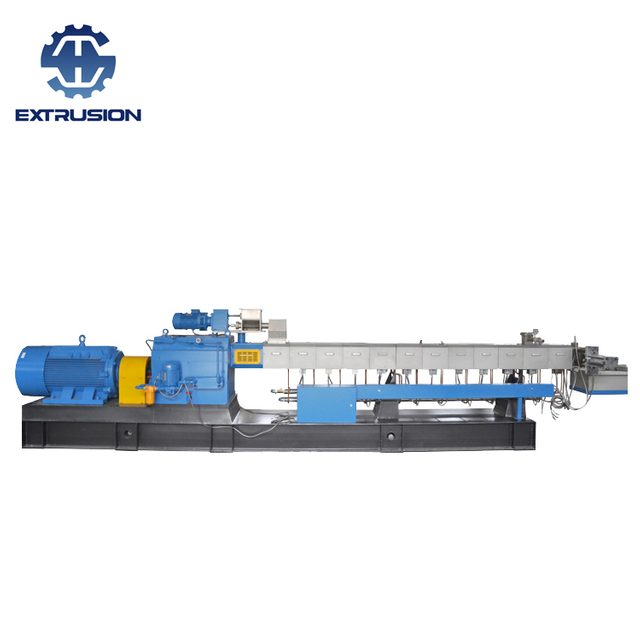
Cylindrical Strand Pellets: When recycled plastics or engineering compounds are melt-filtered and upgraded, producers frequently utilize a strand pelletizer extruder setup. Molten strands exit a horizontal die, cool in an open water bath, pass through an air knife, and enter a mechanical strand cutter. This process yields uniform cylindrical pellets.
Strand pelletizing is a mature, versatile technology widely used across color masterbatch, glass-fiber compounding, and recycling lines. Ultimately, resin quality is determined by purity, moisture content, melt flow index (MFI), and batch consistency—not solely by whether the pellet is spherical or cylindrical.
In large-scale polymer manufacturing, uniform pellet geometry is the physical signature of a standardized, tightly controlled production process. Consistent granules prevent hopper bridging, protect pneumatic conveying systems from dust buildup, and stabilize melt quality in downstream molding and extrusion.

Whether your production requires a high-output underwater pelletizing system for spherical beads or a heavy-duty strand pelletizer extruder line for compounding and recycling, contact the engineering team at Nanjing Haisi Extrusion Machinery for tailored equipment configurations.